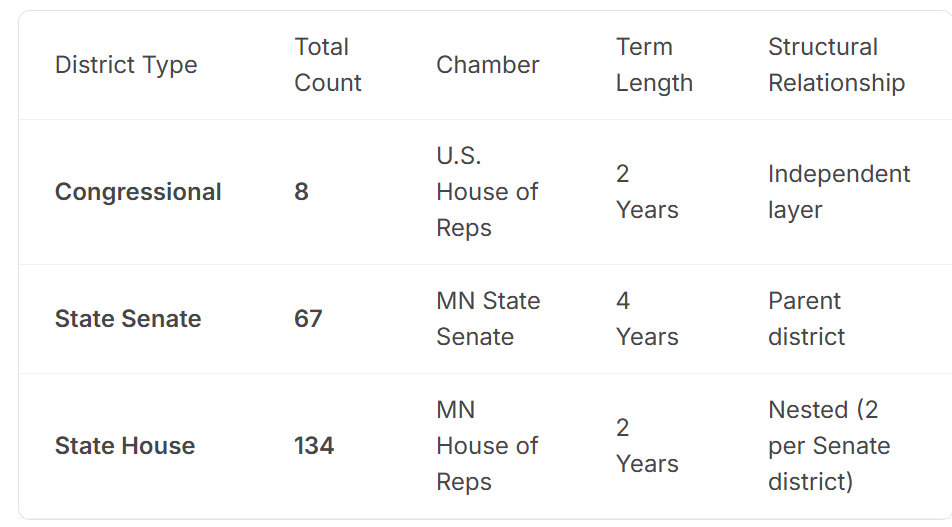
Minnesota utilizes three distinct tiers of political districts: 8 congressional districts for the U.S. House, 67 Senate districts for the state Senate, and 134 House districts for the state House of Representatives. The key structural difference is that state House districts are nested, meaning every Senate district is subdivided into exactly two House districts, whereas congressional districts operate as a separate, independent layer of mapping.
Scope and Representation Congressional districts determine representation in the federal U.S. House, with each of the 8 seats representing approximately equal shares of the state's total population. In contrast, the 67 state Senate districts elect one senator each to four-year terms, while the 134 state House districts elect one representative each to two-year terms. While congressional boundaries must achieve near-perfect population equality under federal standards, state legislative districts allow for slightly larger population deviations.
Mapping and Hierarchy The Minnesota Constitution mandates that state Senate districts be contiguous and that House districts remain nested within Senate districts. All district lines are redrawn every 10 years following the U.S. Census; if the state Legislature and Governor fail to agree on new maps by the statutory deadline, a Special Redistricting Panel of judges imposes the final boundaries, as occurred most recently in February 2022.
In Martin County we are in Congressional District 1
We are in Senate District 22 and 21
We are in House District 22A and 21B
For more information about the districts and maps visit: https://gis.lcc.mn.gov/